
Replanteamiento de la proporcionalidad en los límites del cadmio en el grano de cacao crudo seco sin procesar
Resumen
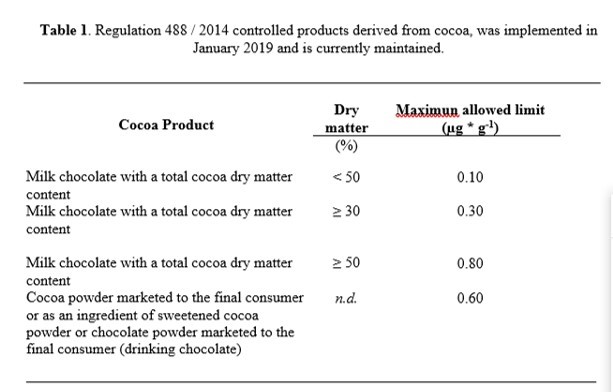
El cadmio (Cd) se bioacumula en los granos de cacao (Theobroma cacao L.), afectando la salud humana y el potencial de comercialización. La Unión Europea (UE) aprobó en 2019 el Reglamento No. 488/2014 para el cacao procesado, y dio lugar a investigaciones sobre la bioacumulación en los granos, los riesgos potenciales para la salud, la calidad del producto y el potencial de exportación. Resultados muestran altos niveles de Cd en cacao de diferentes regiones de América Latina. Este reglamento no establece límites máximos para el cacao sin transformar. Utilizando estos parámetros como referencia a los límites del cacao procesado, ocurre una sobreestimación de la concentración de metales, disputas y distorsión comercial. Aquí se examinan niveles de Cd en almendras de cacao, se justifica el inadecuado uso del reglamento y se proponen máximos para almendras y sus consecuencias. Esto proporciona una nueva categorización a los límites máximos Cd para las almendras de 1,14 μg g-1, 1,22 μg g-1 y 1,02 μg g-1 reduciendo significativamente los valores (según la UE), de 70,59 a sólo 30,53 %; una cifra razonable y adecuada para el cacao no transformado. Los análisis de las fracciones de semillas y de productos primarios muestran dónde está la variabilidad en las concentraciones de Cd.
Descargas
Citas
Abt E., Robin L. P. (2020). Perspective on cadmium and lead in cocoa and chocolate. Journal of Agricultural and Food Chemistry, 68, 13008-13015. DOI: 10.1021/acs.jafc.9b08295
Alvarado Y., Ferrer R., Florida-Rofner N. (2020). Evaluación ex post al proyecto productivo alternativo de Bella Bajo Monzón. Ciencia Unemi, 13(34), 47-58. ISSN electrónico 2528-7737.
Antoine, J. M. R., Fung, L. A. H., Grant, C. N. (2017). Assessment of the potential health risks associated with the aluminium, arsenic, cadmium and lead content in selected fruits and vegetables grown in Jamaica. Toxicology reports. 4, 181-187. DOI: 10.1016/j.toxrep.2017.03.006
APHA. 1992. Standard Methods for the Examination of Water and Wastewater. 18th edition. American Public Health Association (APHA), American Water Works Association (AWWA) and Water Pollution Control Federation (WPCF), Washington, DC.
Argüello, D., Chávez, E., Lauryssen, F., Vanderschueren, R., Smolders, E., Montalvo, D. (2019). Soil properties and agronomic factors affecting cadmium concentrations in cacao beans: A nationwide survey in Ecuador. Science of The Total Environment, 49, 120-127. doi.org10. 1016j.scitotenv.2018.08.22
Barraza, F., Moore, R. E. T., Rehkämper, M., Schreck, E., Lefeuvre, G., Kreissig, K., Coles, B. J., Maurice, L. (2019). Cadmium isotope fractionation in the soil–cacao systems of Ecuador: a pilot field study. Royal Society Chemistry (RSC)Advances, 9, 34011-34022. DOI: 10.103c9ra05516a
Burt R., Wilson M. A., Mays M. D., Lee C. W. (2003). Major and trace elements of selected pedons in the USA. Journal of Environmental Quality, 32(6), 2109-21. https://doi.org/10.2134/jeq2003.2109
Elmatsani, H. M., Munarso, J., Rahardjo, Y. P., Benyamin, B. O., Sjafrina, N., Astut, P., Arianto, A., Lukas, A., Djafar, M. J. (2024). Reducing Cadmium and Lead Contamination in Cacao: A Bibliometric Analysis of 10 Years of Research Using Bibliometrics. BIO Web of Conferences. 101, 01011 https://doi.org/10.1051/bioconf/202410101011 5th ICOLIB.
Engbersen, N., Gramlich, A., López, M., Schwarz, G., Hattendorf, B., Gutiérrez, O., Schulin, R. (2019). Cadmium accumulation and allocation in different cacao cultivars. Science of the total environment, 678(8), 660-670. 10.1016/j.scitotenv.2019.05.001
Florida-Rofner, N. (2021). Review on maximum limits of cadmium in cocoa (Theobroma cacao L.). La Granja, 34 (2), 117-130. http://doi.org/10.17163/lgr.n34.2021.08
Gramlich, A., Tandy, S., Gauggel, C., López, M., Perla, D., González, V., Schulin, R. (2018). Soil cadmium uptake by cocoa in Honduras. Science of the Total Environment. 612, 370-378. https://doi.org/10.1016/j.scitotenv.2017.08.145
He, S., He, Z., Yang, X., Stoffella, P. J., Baligar, V. C. (2015). Soil biogeochemistry, plant physiology, and phytoremediation of cadmium-contaminated soils. Advances in agronomy. 34, 135-225. doi.org/10.1016/bs.agron.2015.06.005
Intriago, F. G., Talledo, M. V., Cuenca, G. J., Macías, J. R., Álvarez, J. R., Menjívar, J. C. (2019). Evaluation of heavy metal content in cocoa almonds (Theobroma cacao L.) during the beneficiary process. PRO-SCIENCES: Revista de Producción, Ciencias e Investigación, 3, 17-23. E-ISSN: 2588-1000.
Khan, A., Khan, S., Khan, M. A., Qamar, Z., Waqas, M. (2015). The uptake and bioaccumulation of heavy metals by food plants, their effects on plants nutrients, and associated health risk: a review. Environ Sci. Pollut. Res. 22:13772–13799. DOI 10.1007/s11356-015-4881-0
Kruszewski, B., Obiedziński, M. W. (2018a). Multivariate analysis of essential elements in row cocoa and processed chocolate mass material from three different manufactures. LWT- Food Science and Technology 98, 113-123. doi.org10.1016 J.lwt.2018.08.030
Kruszewski, B., Obiedziński, M. W., Kowalska, J. (2018b). Nickel, cadmium and lead levels in raw cocoa and processed chocolate mass materials from three different manufacturers. Journal of Food Composition and Analysis, 66, 127-135. DOI: 10.1016/j.jfca.2017.12.012
Lanza, J. G., Churión, P. C., Liendo, N. J., López, V. H. (2016). Evaluación del contenido de metales pesados en cacao (Theobroma cacao L.) de Santa Bárbara del Zulia, Venezuela. Saber, 28(1), 106-115. http://ve.scielo.org/scielo.php?script=sci_arttext&pid=S1315-01622016000100011&lng=es&nrm=iso>. ISSN 2343-6468.
Maddela, N. R., Dhatri Kakarla D.,García, L. C., Chakraborty, S., Kadiyala Venkateswarlu, K., Megharaj, M. (2020). Cocoa-laden cadmium threatens human health and cacao economy: A critical view. Science of The Total Environment 720, 2020, 137645. http://doi.org/10.1016/j.scitotenv.2020.137645
Martínez, C. E., Motto, H. L. (2000). Solubility of lead, zinc and copper added to mineral soils. Environmental Pollution. 107(1), 153-158. https://doi.org/10.1016/S0269-7491(99)00111-6
Meter, A., Atkinson, R., Laliberte, B. (2019). Cadmio en el cacao de América Latina y el Caribe. Análisis de la investigación y soluciones potenciales para la mitigación. 84 pp. Biodiversity International. Online: https://bit.ly/3baF nwA. ISBN:978-92-9255-136-0
Pastor, S., (2017). Niveles de cadmio en el chocolate: NM y ECA, sí; OTC, no. In: International Symposium on Cocoa Research (ISCR). pp, 1-5.
Pastor, S., Gutiérrez, M. (2016). Sobre los fundamentos de una norma que regula el cadmio en los alimentos y presume del mismo en el suelo. Memorias del XXI Congreso Latinoamericano de la Ciencia del Suelo. pp, 24-28.
Ramírez, R., (2022). Contaminación de suelos y cultivos con metales pesados y nutrientes en Venezuela. Revista Facultad Agronomía (UCV). 48: 01 - 17.
Reyes, Y., Vergara, I., Torres, O., Díaz, M., González, E. E. (2016). Contaminación por metales pesados: Implicaciones en salud, ambiente y seguridad alimentaria. Ingeniería Investigación y Desarrollo: I2+ D. ISSN-e 2422-4324, ISSN 1900-771X. 16 (2), 66-77.
Sánchez, A. S., Naranjo, J. A., Córdova, V., Ávalos, D. A., Zaldívar, J. M. (2016). Caracterización bromatológica de los productos derivados de cacao (Theobroma cacao L.) en la Chontalpa, Tabasco, México. Revista Mexicana de Ciencias Agrícolas, 7 (14), 2817-2830.
Unión Europea-UE. Regulation No. 488/2014. (2014). They modify EC Regulation No 1881/2006 regarding the maximum content of cadmium in food products. Official Journal of the European Union. Online: https://bit.ly/3uvfOxT
Ure A. M., Quevauviller Ph., Muntau H., Griepink B. (1993). Speciation of Heavy Metals in Soils and Sediments. An Account of the Improvement and Harmonization of Extraction Techniques Undertaken Under the Auspices of the BCR of the Commission of the European Communities. International Journal of Environmental Analytical Chemistry, 51, 135-151. https://doi.org/10.1080/03067319308027619
Vanderschueren R., Argüello D., Blommaert H., Montalvo D., Barraza F., Maurice L., Schreck E., Schulin R., Lewis C., Vázquez J., Umaharan P., Chávez E., Sarret G., Smolders E. (2021). Mitigating the level of cadmium in cacao products: Reviewing the transfer of cadmium from soil to chocolate bar. Science of the Total Environment, 781, 146779. https://doi.org/10.1016/j.scitotenv.2021.146779
Zug K. L. M., Huamani Yupanqui, H. A., Meyberg F., Cierjacks J. S., Cierjacks A. (2019). Cadmium accumulation in Peruvian cacao (Theobroma cacao L.) and opportunities for mitigation. Water, Air, and Soil Pollution, 230, 1-18. 10.1007/s11270-019-4109-x
Copyright
La Revista Técnica de la Facultad de Ingeniería declara que los derechos de autor de los trabajos originales publicados, corresponden y son propiedad intelectual de sus autores. Los autores preservan sus derechos de autoría y publicación sin restricciones, según la licencia pública internacional no comercial ShareAlike 4.0


_2.04__.27_p__._m__.__.png)


